







Why WIGTN Plugins?
Without this plugin: You open Claude Code → write a vague prompt → get generic code → spend 30 min fixing → repeat.
With WIGTN Plugins:
You run /prd → get a structured contract → generate screen specifications when needed → implement → commit only after the configured checks pass.
What it does
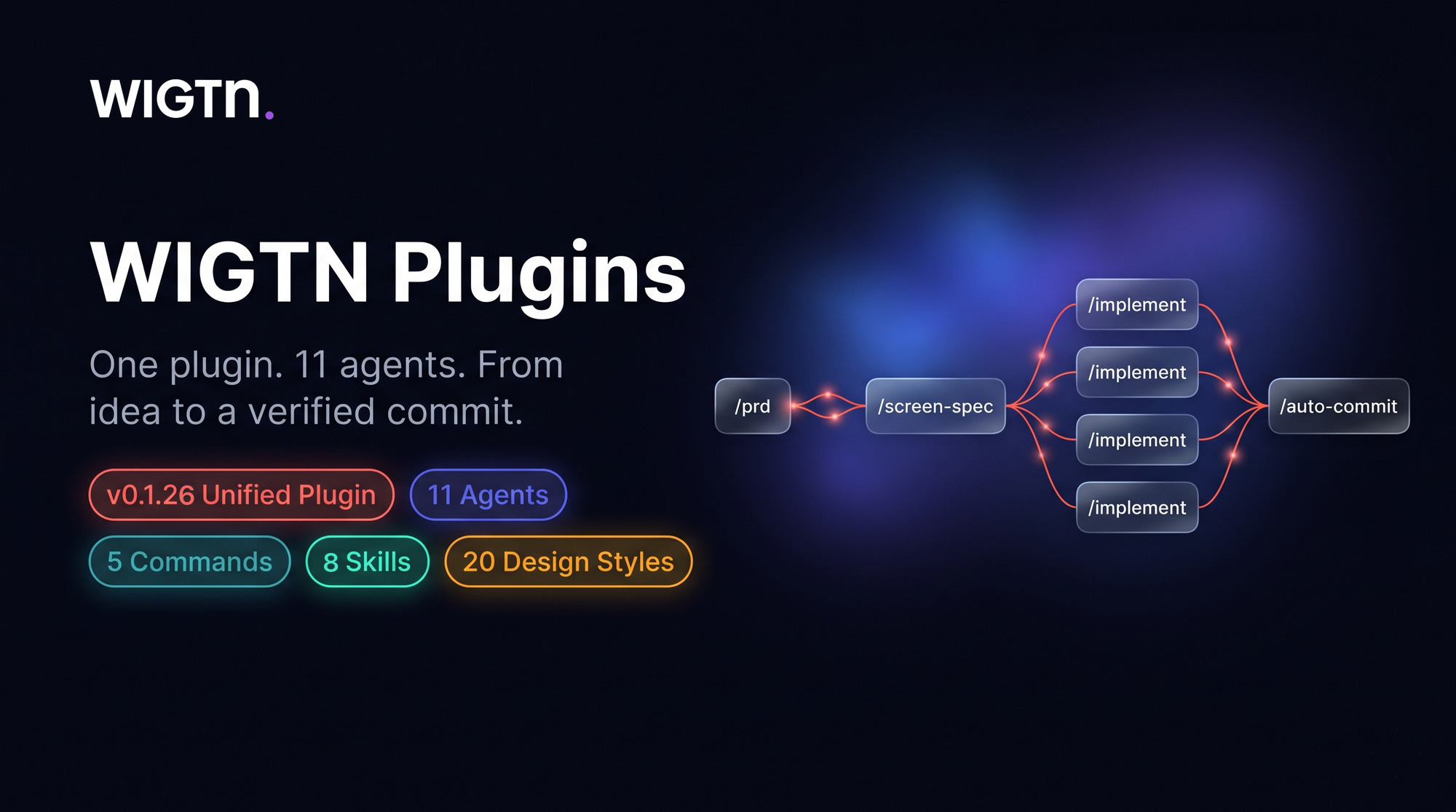
WIGTN Plugins is a Claude Code plugin with 11 specialized agents for requirements, architecture, implementation, and review. It uses parallel work only where tasks are independent, and carries one contract from PRD through commit.
For WIGTN members it also keeps a team knowledge wiki: what you learn in WIGTN repos is collected and comes back as context in later work (details).
/prd "SaaS dashboard with OAuth" → Contract-based PRD + task plan
/screen-spec dashboard → (if UI) IA + flow + screen spec + clickable wireframe HTML
/implement --parallel → Backend + Frontend + AI + Ops teams build simultaneously
/auto-commit → Findings rollup + objective checks + commit
Quick Start
# Install
/plugin marketplace add wigtn/wigtn-plugins
/plugin install wigtn-plugins@wigtn-plugins
# Try it — this is the full workflow
/prd landing page for an AI startup with modern design
/implement ai-landing
/auto-commit
That's it. The plugin handles PRD generation, 4-category quality analysis, architecture decisions, design style selection, parallel build, code review, and commit.
The Pipeline
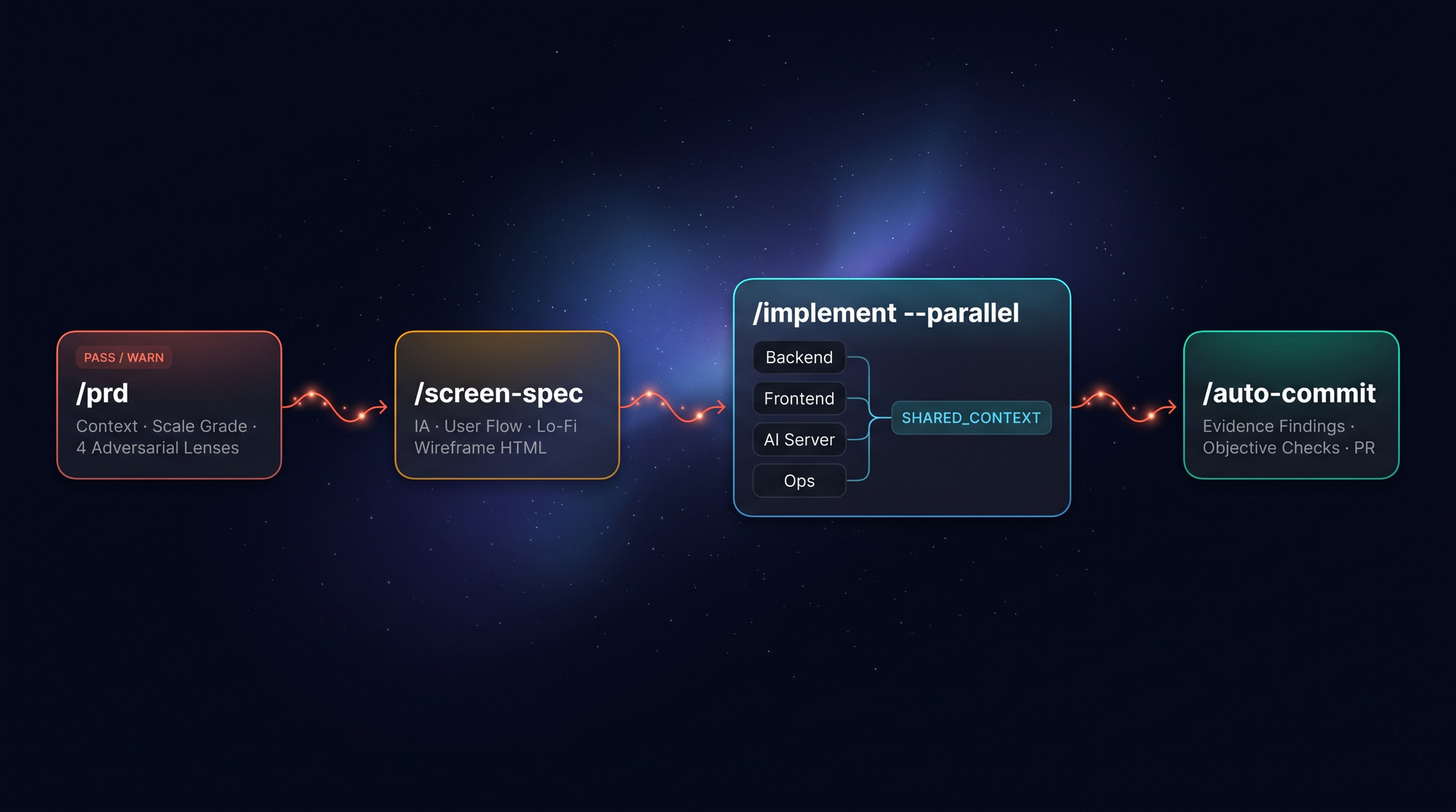
┌─────────────────────────────────────────────────────────────────────────────┐
│  /prd "SaaS dashboard with OAuth"                                          │
│                                                                             │
│  1. Context Gathering ─── scan project structure, tech stack, package.json  │
│  2. AskUserQuestion ───── Scale Grade? (Hobby / Startup / Growth / Enterprise) │
│  3. PRD Generation ────── PRD_{feature}.md  (7 sections, Gherkin stories)  │
│  4. Task Planning ─────── PLAN_{feature}.md (phases + tasks)               │
│                                                                             │
│  ┌─── prd-reviewer — 4 adversarial lenses ────────────────────────────┐    │
│  │  Phase 0: Context Harvest (CLAUDE.md, code patterns, deps)         │    │
│  │  Phase 1: PRD Structure Parsing                                    │    │
│  │  Phase 2: ═════════════ 4 ADVERSARIAL LENSES ══════════            │    │
│  │           │ Completeness │ Feasibility │ Security │ Consistency │   │    │
│  │           │ FR/NFR/edge  │ stack fit   │ OWASP    │ naming/arch │   │    │
│  │           │ cases, dups  │ blast radius│ auth/z   │ PRD↔code    │   │    │
│  │  Phase 3: Cross-Category Synthesis (compound risks)                │    │
│  │  Phase 4: Quality Gate ─── PASS / WARN / BLOCKED                   │    │
│  └────────────────────────────────────────────────────────────────────┘    │
└─────────────────────────────────────────────────────────────────────────────┘
                                    │
                          BLOCKED → stop
                                    │ PASS / WARN
                                    ▼
┌─────────────────────────────────────────────────────────────────────────────┐
│  /implement ai-landing                                                      │
│                                                                             │
│  ┌─── DESIGN PHASE ──────────────────────────────────────────────────┐     │
│  │  ═══════════════ 3 AGENTS IN PARALLEL ═══════════════             │     │
│  │  │ Agent A          │ Agent B              │ Agent C          │   │     │
│  │  │ PRD load +       │ architecture-decision│ Project scan +   │   │     │
│  │  │ quality gate     │ Mono/Modular/MSA     │ gap analysis     │   │     │
│  │  ══════════════════════════════════════════════════════════════    │     │
│  │                          │                                        │     │
│  │  Team Allocation ─────── pattern match files → teams              │     │
│  │    api/, services/   → Backend                                    │     │
│  │    components/, app/ → Frontend                                   │     │
│  │    ai/, llm/         → AI Server                                  │     │
│  │    Dockerfile, CI/   → Ops                                        │     │
│  │                                                                   │     │
│  │  Design Discovery (Frontend only, if no existing style) ────────  │     │
│  │    VS technique: 4 questions → suitability % per style → select   │     │
│  │                                                                   │     │
│  │  ✋ CHECKPOINT: AskUserQuestion ── proceed / review / cancel      │     │
│  └───────────────────────────────────────────────────────────────────┘     │
│                                                                             │
│  ┌─── BUILD PHASE ─── team-build-coordinator ────────────────────────┐     │
│  │                                                                   │     │
│  │  Phase 0: Setup ─── SHARED_CONTEXT_{feature}.md + PLAN ledger    │     │
│  │           Context Harvest: sample existing code → learn patterns   │     │
│  │                                                                   │     │
│  │  Phase 1: Foundation (if Backend + dependents exist)              │     │
│  │           Backend writes: DB schema, shared types, API contracts   │     │
│  │                    ↓ unblocks other teams                         │     │
│  │                                                                   │     │
│  │  Phase 2: ════════════ UP TO 4 TEAMS IN PARALLEL ════════════     │     │
│  │           │ BACKEND        │ FRONTEND       │ AI SERVER    │ OPS │     │
│  │           │ backend-       │ frontend-      │ ai-agent     │ gen │     │
│  │           │ architect      │ developer      │              │ pur │     │
│  │           │                │ + style guide  │              │     │     │
│  │           │ API, services  │ pages, comps   │ LLM, STT    │ CI  │     │
│  │           │ DB, middleware │ state, styling │ prompts      │ CD  │     │
│  │           ════════════════════════════════════════════════════     │     │
│  │           ▲ reads                  │ writes                       │     │
│  │           └──── SHARED_CONTEXT ────┘                              │     │
│  │                                                                   │     │
│  │  Phase 3: Integration ─── API contract match, type consistency,   │     │
│  │           pattern verification vs Phase 0 learned patterns        │     │
│  │                                                                   │     │
│  │  Phase 4: Build & Test ─── typecheck + test + build               │     │
│  └───────────────────────────────────────────────────────────────────┘     │
└─────────────────────────────────────────────────────────────────────────────┘
                                    │
                                    ▼
┌─────────────────────────────────────────────────────────────────────────────┐
│  /auto-commit                                                               │
│                                                                             │
│  Step 1: Branch Strategy                                                    │
│          on feature branch → reuse │ on main + PLAN → feat/<name>          │
│                                                                             │
│  Step 2: Quality Gate                                                       │
│  ┌─── code-reviewer — evidence-backed findings ───────────────────┐        │
│  │  Each finding: file + line + severity + confidence + evidence  │        │
│  │                                                                 │        │
│  │  FAIL  ← critical ≥1                                            │        │
│  │  WARN  ← critical 0 AND (major ≥1 OR minor ≥5)                  │        │
│  │  PASS  ← critical 0 AND major 0 AND minor <5                    │        │
│  └─────────────────────────────────────────────────────────────────┘        │
│                                                                             │
│  Step 3: Objective Checks ─── typecheck / lint / configured checks          │
│          non-zero exit → blocked                                            │
│  Step 4: Commit Message ─── <type>(<scope>): <subject> + gate result       │
│  ✋ CHECKPOINT: AskUserQuestion ── PR / Draft PR / Commit only / Cancel    │
│  Step 5: git commit → git push -u → gh pr create                           │
└─────────────────────────────────────────────────────────────────────────────┘

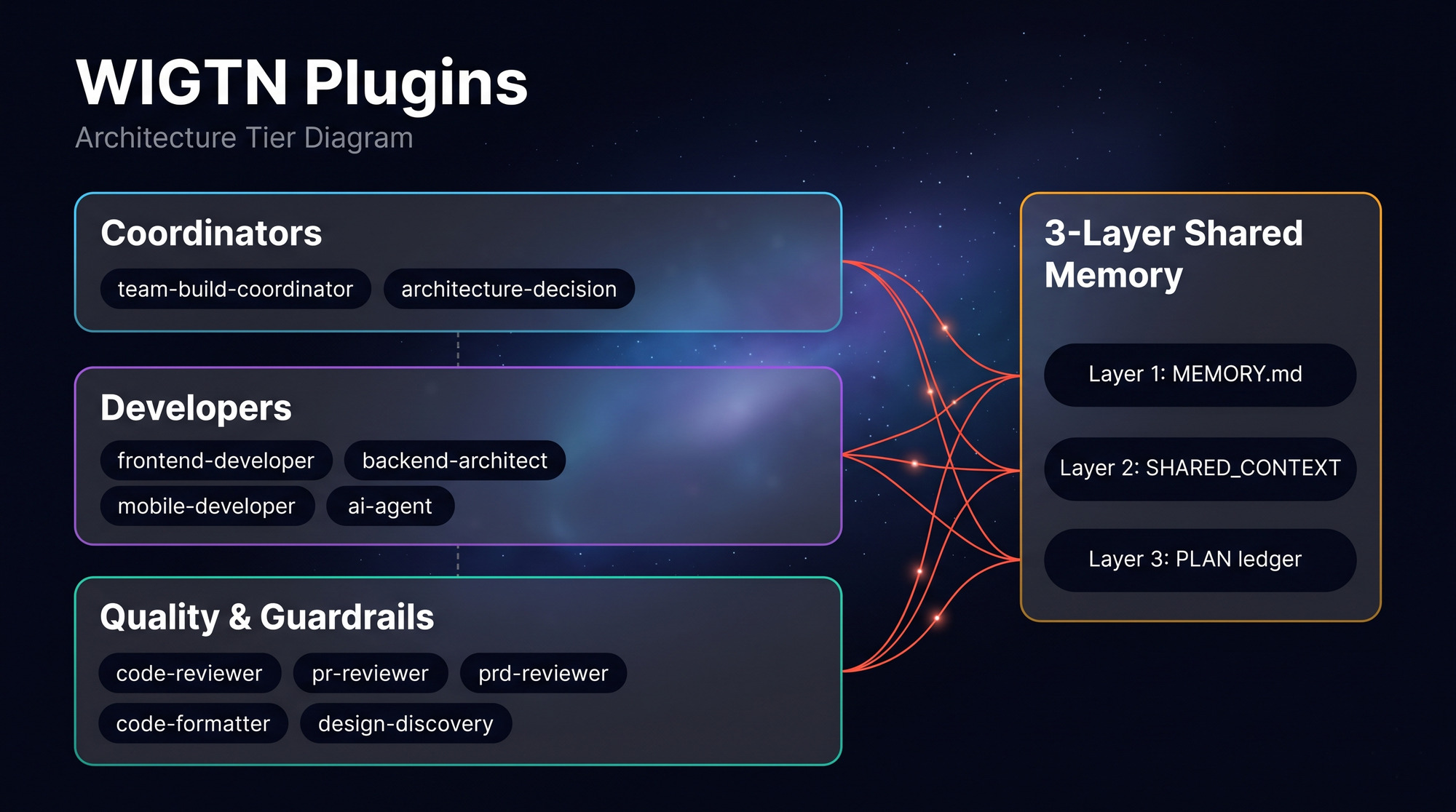
Shared Memory (3 layers):
  Layer 1 — MEMORY.md ─────────── persistent cross-session conventions
  Layer 2 — SHARED_CONTEXT ────── session-scoped API contracts, types, patterns
  Layer 3 — PLAN ledger ───────── task checkboxes + execution log
Independent steps can run in parallel; dependent steps remain ordered. Runtime varies with the task, model, and configured checks.
Commands
| Command | What it does |
|---|---|
/prd <feature> |
Generate PRD + phased task plan from a feature idea (now includes User Roles, Page State Matrix, User Flow sections for UI features) |
/screen-spec <feature> |
Optional UI gate: IA + User Flow + Screen Spec + clickable HTML wireframe + Dev Handoff. Lo-fi wireframe (grayscale + semantic colors); style is decided later at /implement |
/implement <feature> |
Design + build with automatic parallel team dispatch (consumes screen-spec output if present) |
/auto-commit |
Evidence-backed findings → deterministic rollup → objective checks → commit + PR |
/review-pr <PR> |
Review a GitHub PR from terminal: diff analysis, severity findings, inline comments |
Team Knowledge Wiki
For WIGTN members. The plugin collects nothing outside github.com/wigtn/ repos unless you configure a wiki yourself.
| When | What happens |
|---|---|
| End of each response | The session is rewritten as a short note on what was learned (not what was done), screened by a four-step gate for secrets, personal data, and client identifiers, then pushed to per-user/<you>/ in wigtn/wigtn-team-wiki (private) |
| Each prompt | Up to 3 related notes (title + one-line summary) are added to the context |
| Session start | Pulls teammates' notes and pushes anything a previous session could not push |
- Each note gets one field from a fixed legend (AI, MLOps, Back-End, Front-End, DevOps, DataBase, Design-Pattern, SRE, Algorithm, Math, Research) and a few tags. The wiki builds
INDEX.mdand field, project, and tag pages from them, and can be viewed as a graph withopenwiki visualize. - To take part you need write access to the wiki repo and git credentials for GitHub.
excludeandenabled: falsein~/.wigtn/knowledge-wiki.ymlalways win. - Policy:
contracts/INGEST-POLICY.md. Setup and diagnosis:skills/knowledge-wiki/SKILL.md.
Agents (11) — click to expand
Coordinators
| Agent | Role |
|---|---|
team-build-coordinator |
Dispatches Backend, Frontend, AI, Ops teams in parallel |
architecture-decision |
MSA vs Monolithic vs Modular Monolith |
Developers
| Agent | Role |
|---|---|
frontend-developer |
React 19, Next.js 16+, 20 design styles |
backend-architect |
API design, database schema, backend patterns |
mobile-developer |
React Native / Expo, native modules |
ai-agent |
WhisperX STT, OpenAI/Anthropic integration |
Quality
| Agent | Role |
|---|---|
code-reviewer |
Evidence-backed findings with deterministic PASS/WARN/FAIL rollup |
pr-reviewer |
GitHub PR diff review, severity findings, inline review comments (used by /review-pr) |
prd-reviewer |
Finds gaps across completeness, feasibility, security, consistency |
code-formatter |
Multi-language auto-formatting and lint fixes |
design-discovery |
VS-based style recommendation for Web and Mobile |
Skills (8) — click to expand
| Skill | What it provides |
|---|---|
code-review-levels |
Deep review (Level 3: call chains, edge cases, concurrency) and architecture review (Level 4: SOLID, layer violations, scalability) |
design-system-reference |
20 style guides with typography, color, components, motion, and anti-patterns. Works with design-discovery for context-aware recommendations |
architecture-diagram |
Draws architecture / flow diagrams as committable hand-drawn SVG + PNG (Excalidraw / Mermaid handDrawn look: rough outlines, pastel hachure, Korean handwriting titles; a clean style too). Labels are measured in a real browser before ELK layout so text never clips, fonts are embedded in the SVG, and a layout check fails the render on overflow or overlap |
knowledge-wiki |
Settings, policy, diagnosis, and manual runs for the team knowledge wiki. The hooks collect and recall automatically; this skill is for checking and adjusting them |
paper-scout |
Fetches recent arXiv papers, adds Hugging Face Daily Papers upvotes as a popularity signal, and skips ones already shown, and picks the ones that match your interest profile (~/.config/wigtn/paper-scout/profile.md, falling back to references/profile.md), summarized in Korean. On request it reads one paper's TeX source and figures in depth. Semantic Scholar and OpenReview are not wired in |
screen-spec |
Generates 5 UI artifacts from PRD — IA, User Flow, Screen Spec, clickable Wireframe HTML, Dev Handoff. Lo-fi wireframe (grayscale + semantic colors); style decisions deferred to /implement. Invoked by /screen-spec |
team-memory-protocol |
SHARED_CONTEXT management for cross-agent coordination during parallel builds |
wigtn-ppt |
Builds a talk or briefing as an editable .pptx, story first: a one-sentence thesis and a stage map (the agenda), then each slide's claim title, lead, evidence, hero number and source. A checker blocks topic-only titles, numbers without a source, a proposal with no counter-argument before it, text that overflows, and Korean spacing errors before anything is built. 16 layouts on a fixed grid (title 28pt, lead 16pt, readable text 14pt or more); native charts, SVG pictures PowerPoint can convert to shapes, speaker notes; LibreOffice render for review. WIGTN Light/Dark and neutral themes, or a theme file. HTML output is still available |
Design Styles (20) — click to expand
Each style guide covers philosophy, typography, layout, color, components, motion, and an anti-pattern checklist.
| Style | Vibe |
|---|---|
| Editorial | Magazine layouts, strong serif typography |
| Brutalist | Raw, bold, unconventional |
| Glassmorphism | Frosted glass, blur, transparency |
| Swiss Minimal | Grid-based, typography-focused |
| Neomorphism | Soft UI, inset/outset shadows |
| Bento Grid | Card-based grid (Apple-inspired) |
| Dark Mode First | Dark interfaces from the ground up |
| Minimal Corporate | Clean professional aesthetic |
| Retro Pixel | CRT effects, monospace, terminal nostalgia |
| Organic Shapes | Blobs, natural curves, earthy tones |
| Maximalist | Bold type, intense colors, layered |
| 3D Immersive | CSS 3D transforms, parallax, depth |
| Liquid Glass | Fluid translucent glass, dynamic reflections |
| Claymorphism | Soft 3D clay elements, pastel tones |
| Minimalism | Extreme simplicity, whitespace-driven |
| Neobrutalism | Colorful accents, bold borders |
| Skeuomorphism | Realistic textures, physical metaphors |
| Aurora / Gradient Mesh | Mesh gradients, ambient glow, ethereal |
| Terminal / Hacker | Monospace-driven, information-dense, semantic color |
| Kinetic Typography | Scroll-driven text animation, split reveals |
The design-discovery agent recommends the best style for your project context using VS (Verbalized Sampling).
Hooks (6) — click to expand
| Hook | Trigger | What it does |
|---|---|---|
| Dangerous Command Blocker | Bash PreToolUse |
Blocks rm -rf /, git push --force, git reset --hard, DROP TABLE |
| Commit Quality Gate | Bash PreToolUse (git commit) |
Runs hooks/gate.sh: blocks an /auto-commit commit without a fresh gate PASS, and runs .wigtn/checks.sh (typecheck/lint) — non-zero blocks the commit |
| Gate Health Check | SessionStart | Warns you and Claude when the gate script can't be resolved (commits would pass unchecked) |
| Knowledge Wiki | Stop (async) | Accumulates session learnings into the team wiki through the policy gate. Work in github.com/wigtn/ repos goes to wigtn-team-wiki wherever the folder lives; other repos only when configured |
| Knowledge Wiki Recall | UserPromptSubmit | Adds up to 3 related wiki notes (title + one-line summary, 1,200 chars max) to the context. Reads only the wiki this repo writes to, so excluded repos get nothing |
| Knowledge Wiki Sync | SessionStart (async) | Pulls teammates' new notes and pushes commits a previous session could not push. Clones the wiki on first run |
Scenarios
Full-Stack SaaS from scratch
/prd project management tool with kanban boards and team collaboration
# → 4-lens analysis catches: "Missing: real-time sync, role permissions"

/implement --parallel project-management
# Backend: API endpoints, Prisma schema, auth middleware
# Frontend: Kanban board, team views, dashboard
# Ops: Dockerfile, GitHub Actions CI/CD

/auto-commit
# findings rollup PASS + objective checks pass → auto-commit
Mobile app with React Native
/prd fitness tracker with workout logging, progress charts, Apple Health sync

/implement fitness-tracker
# Expo Router + Zustand + MMKV + React Query
# Biometric auth, haptic feedback, offline sync
Design-driven landing page
/prd AI startup landing page with modern design

/implement ai-landing
# design-discovery activates → recommends Glassmorphism or Liquid Glass
# Frontend team builds Hero, Features, Pricing, CTA with chosen style
Backend API + AI features
/prd transcription service with WhisperX STT and LLM summarization

/implement --parallel transcription-service
# Backend → API + DB + auth
# AI → WhisperX + OpenAI/Anthropic patterns
# Frontend → Upload UI + transcription viewer
Tech Stack
| Domain | Technologies |
|---|---|
| Frontend | React 19, Next.js 16+, Tailwind CSS, Radix UI |
| Backend | NestJS, Express, FastAPI, Prisma, Drizzle |
| Mobile | React Native 0.73+, Expo SDK 52+ |
| AI | WhisperX, OpenAI GPT, Anthropic Claude |
| DevOps | Docker, Kubernetes, GitHub Actions |
| Design | 20 style systems, VS-based discovery, HIG, MD3 |
Contributing
See CONTRIBUTING.md for layout, conventions, and versioning. Before opening a PR, run the checks CI runs:
python3 .github/scripts/validate_plugin.py      # manifests, counts, version
python3 .github/scripts/check_contracts.py      # prompt contracts, hooks schema
python3 .github/scripts/test_knowledge_wiki.py  # knowledge-wiki boundaries (no model calls)
bash .github/scripts/test_gate.sh && bash .github/scripts/test_danger_hook.sh && bash .github/scripts/test_context_scripts.sh
License
Apache License 2.0 — see LICENSE.
Built by WIGTN
An independent AI team in Korea that builds for clients and publishes in the open.