📚 okf: the Open Knowledge Format toolkit for Claude Code
Teach your coding agent to author, maintain, validate, and visualize portable knowledge bundles: markdown your team and your agents both read.
Built for OKF v0.2 (trust signals, provenance, staleness), while the rest of the ecosystem still targets v0.1.





▶ Open the live demo: a real OKF bundle as an interactive graph
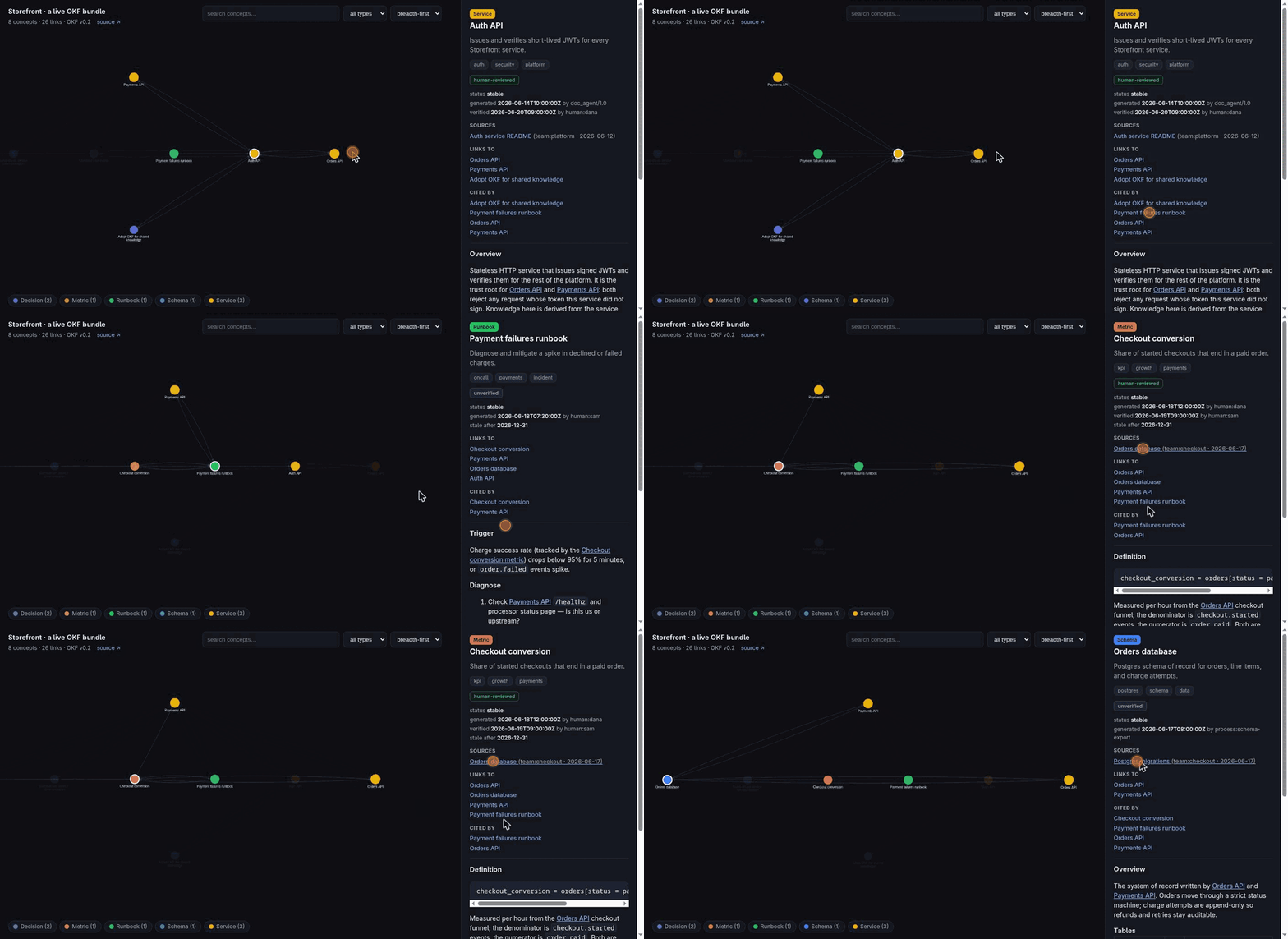
Click any node for rendered markdown, the derived trust tier and staleness, provenance with its credibility signals, and "Links to / Cited by" backlinks. No backend, nothing leaves the page.
/plugin install okf@scaccogatto
npx skills add scaccogatto/okf-skills
OKF is an open, vendor-neutral format (announced by Google Cloud, June 2026) that represents knowledge (the context and curated insight around your systems) as a directory of markdown files with YAML frontmatter. No schema registry, no runtime, no SDK. If you can
cata file you can read it; if you cangit clonea repo you can ship it.
This is the Claude Code-native OKF toolchain. It teaches Claude to produce, maintain, consume, validate, and visualize OKF bundles as a normal part of how it already works, driven by the verbatim spec, backed by a deterministic conformance checker, with a self-contained graph renderer. Ships as a Claude Code plugin, as agent skills (Cursor, Codex, and 20+ agents), and as a GitHub Action for repos with no agent at all. Every other tool in Google's community list still targeted v0.1 when we checked on 2026-07-27; this one is v0.2 throughout.
🪞 This repo documents itself in OKF. The architecture, skills, and decisions behind okf-skills live in
.okf/, explorable as a live self-graph. CI validates that bundle on every push (dogfooding the conformance checker).
Install
As a Claude Code plugin:
/plugin marketplace add scaccogatto/okf-skills
/plugin install okf@scaccogatto
As agent skills via skills.sh (Claude Code, Cursor, Codex, and 20+ agents):
npx skills add scaccogatto/okf-skills # the okf, validate & visualize skills
Local development (no marketplace): claude --plugin-dir /path/to/okf-skills.
Both layouts coexist in this one repo: .claude-plugin/ makes it a plugin
marketplace, skills/<name>/SKILL.md makes it skills.sh-discoverable. Scripts live
inside their skills and are referenced via ${CLAUDE_SKILL_DIR}, so they work in
either path. The scripts need uv (or python3 + pyyaml).
Use it
Capture knowledge: ask Claude to "document the auth service in OKF", or run:
/okf:okf produce .okf
Validate before committing:
/okf:validate .okf --strict
# or directly, zero-config:
uv run skills/validate/scripts/okf_validate.py .okf --strict
# gate in CI while some warnings are still outstanding:
uv run skills/validate/scripts/okf_validate.py .okf --max-warnings 5
Gate it in CI: the composite action works in any repo, with or without Claude Code:
- uses: scaccogatto/okf-skills@v1
  with:
    bundle: .okf
    strict: "true"      # or: max-warnings: "5"
Visualize the knowledge graph, a self-contained viz.html that opens in any
browser (live example):
/okf:visualize .okf
# or directly, with a title and a back-link to your repo:
uv run skills/visualize/scripts/okf_visualize.py .okf \
  -o viz.html --title "My project" --link "https://github.com/me/project"
Every concept gets a shareable deep link (viz.html#services/auth-api opens with
that concept selected). Each panel carries two derived badges: the §5.3 trust
tier (unverified / machine-confirmed / human-reviewed) and staleness once
stale_after is past. OKF stores neither (a stored tier is a stored opinion, and
it goes stale), so both are computed at render time.
Keep it up to date. Two opt-in ways to make upkeep automatic:
- Soft mode: paste
templates/CLAUDE-okf.mdinto your project'sCLAUDE.md(or~/.claude/CLAUDE.md) to have Claude consult.okf/before tasks and write knowledge back after changes. - Enforced mode: add
upkeep: enforcedto.okf/index.md's frontmatter to arm the plugin's dormantStophook, which then blocks finishing when tracked files changed but.okf/log.mdwasn't updated. Off by default; a user overrides any bundle withOKF_HOOK=off. Full gate sequence: stop-hook concept.
What's inside
| Component | What it does |
|---|---|
/okf:okf skill |
Produce / maintain / consume bundles, applying the spec and templates. Auto-triggers when a repo has an OKF bundle. |
/okf:validate skill |
Deterministic §11 conformance check (not an eyeball pass). |
/okf:visualize skill |
Render a bundle to a self-contained interactive HTML graph (viz.html). |
skills/okf/scripts/okf_init.py |
Scaffold a conformant starter bundle in one shot. |
skills/validate/scripts/okf_validate.py |
Standalone, zero-config validator (uv run, PyYAML via PEP 723). |
skills/visualize/scripts/okf_visualize.py |
Standalone bundle→viz.html renderer. |
skills/okf/reference/SPEC.md |
The OKF v0.2 spec, vendored verbatim: the source of truth. |
templates/CLAUDE-okf.md |
Snippet that turns on automatic consume/maintain in your project. |
action.yml |
Composite GitHub Action to gate a bundle in any repo's CI, no Claude Code needed. |
examples/sample-bundle/ |
The conformant bundle behind the live demo. |
How a bundle looks
A bundle is a directory of markdown files; a concept's path is its ID. The only
rule for conformance is YAML frontmatter with a non-empty type; everything else
is optional.
.okf/
├── index.md                  # progressive disclosure (root carries okf_version)
├── log.md                    # ISO-dated change history, newest first
├── services/auth-api.md      # one concept = one file; path is its ID
├── decisions/use-okf.md
└── metrics/checkout-conversion.md
---
type: Service
title: Auth API
description: Issues and verifies short-lived access tokens.
resource: https://github.com/acme/auth
status: stable
generated: { by: doc_agent/1.0, at: 2026-06-14T10:00:00Z }
verified: { by: human:dana, at: 2026-06-20T09:00:00Z }
sources:
  - id: auth-readme
    resource: https://github.com/acme/auth#readme
    title: Auth service README
---

# Endpoints
Tokens live 15 minutes.[^auth-readme]

[^auth-readme]: Auth service README
What OKF v0.2 adds
v0.2 assumes a corpus that agents keep writing, so it makes four things answerable
from frontmatter alone. All optional; a concept carrying only type is still fully
conformant. Full normative detail is in SPEC.md.
| Family | Fields | Answers |
|---|---|---|
| Provenance | sources[] + author / usage_count / last_modified, usage_window |
Where did this come from, and how credible is that source? |
| Trust | generated: {by, at}, verified[], actor convention (human: / process: / agent/version) |
Who wrote it, who confirmed it? |
| Lifecycle | status, stale_after |
Is it current? Is it still true? |
| Attestation | type: Attested Computation + runtime, parameters, executor, attester |
Was this number produced the sanctioned way? |
Upgrading from v0.1? --migrate rewrites the two superseded constructs
(timestamp → generated.at, body # Citations → sources) in place, textually
and idempotently. The tools read both meanwhile and flag the old forms as warnings,
never errors; --strict is the nudge, --migrate is the door:
uv run skills/validate/scripts/okf_validate.py .okf --migrate --strict
Repository layout
okf-skills/
├── .claude-plugin/{plugin.json, marketplace.json}
├── skills/{okf, validate, visualize}/{SKILL.md, scripts/}
├── hooks/                         # the dormant Stop hook
├── examples/sample-bundle/        # the live-demo bundle
├── docs/                          # GitHub Pages: the live interactive demo
├── templates/CLAUDE-okf.md
├── action.yml                     # the CI-gating GitHub Action
├── Makefile                       # make docs / test / validate; CI runs the same
└── .github/workflows/ci.yml
Contributing
Issues and PRs welcome: new templates, producers for more sources, validator and
visualizer improvements. CI validates the plugin manifest and the example bundle on
every push. Releases are automatic: bump version in .claude-plugin/plugin.json
and merging to main tags and publishes okf--v<version> on its own. That bump is
required, not optional: a PR touching the shipped surface (skills/, hooks/,
templates/, action.yml, .claude-plugin/) fails CI until the version is
raised. Docs, .okf/ and tests are exempt; the skip-version-check label
bypasses the gate for a shipped change that warrants no release.
Credits & license
- The Open Knowledge Format specification is by the Google Cloud Data Cloud
team, released under Apache-2.0.
skills/okf/reference/SPEC.mdis vendored verbatim from the reference repository with attribution. - This plugin's own code and content: MIT © Marco Boffo (@scaccogatto).